
What is it? Where does it come from?
If you’ve ever admired a perfectly smooth logo, a clean animation in a mobile app, or the curves of a car, you’ve already seen Bézier curves in action.


Bézier curves are one of those scientific ideas that quietly shape our digital world. They come from mathematics, but today they are used everywhere: in graphic design, video games, user interfaces, engineering, and even animation movies.
They were originally developed in the 1960s for the automotive industry. Engineers needed a way to design smooth and precise shapes for car bodies. Instead of drawing curves by hand, they used mathematical equations that could generate perfectly controlled curves.
How do they work?
A Bézier curve is controlled by a small number of points called control points. Instead of forcing the curve to go through every point, the curve is influenced by them.
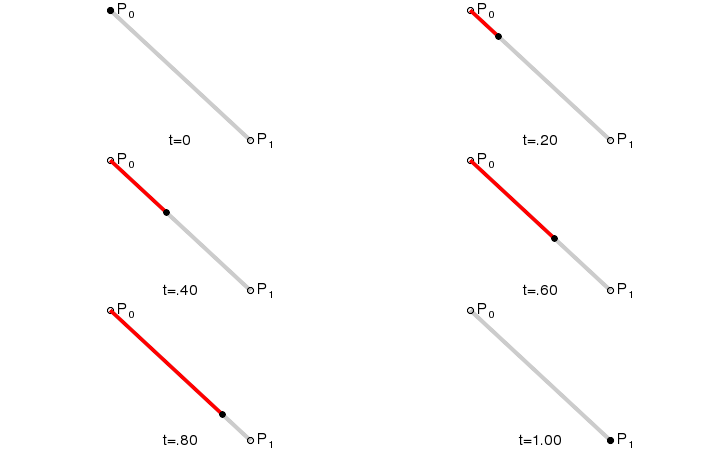
First, we take two points and connect them with a line. Then, we create a point that moves from the first point to the second one, following that line.
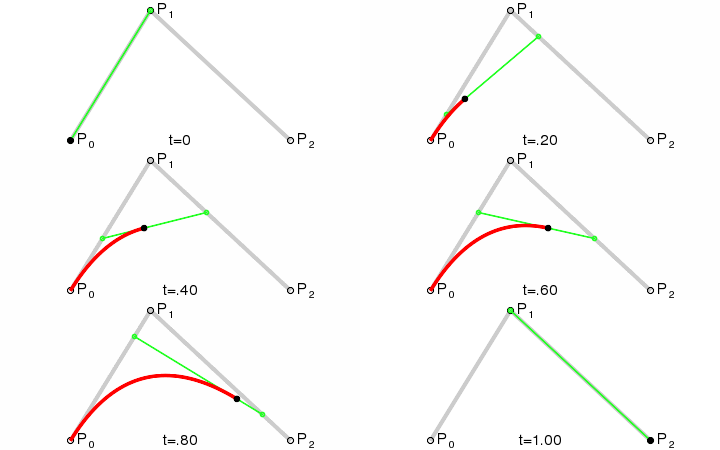
Next, we do the same thing with another pair of points. We now have two moving points, each one sliding along its own line.
Finally, we connect these two moving points with another line, and we add one last point that moves from one to the other. The path followed by this final moving point is what we call a Bézier curve.
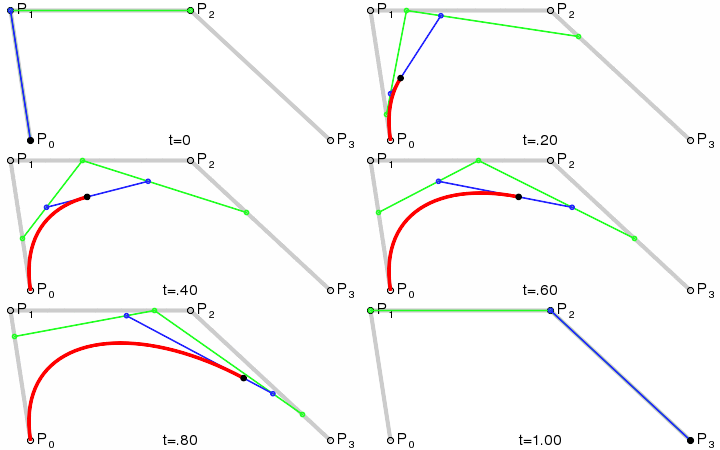
Now we can add as many control points as we want !
Science that you can actually see
What makes Bézier curves fascinating is that they are not just abstract mathematics. They are a perfect example of science applied to creativity.
So the next time you see a clean logo or a smooth animation on your phone, remember: behind that simple curve, there is a beautiful piece of mathematics working silently.